Why Offline-First Apps Are the Future of Personal Finance
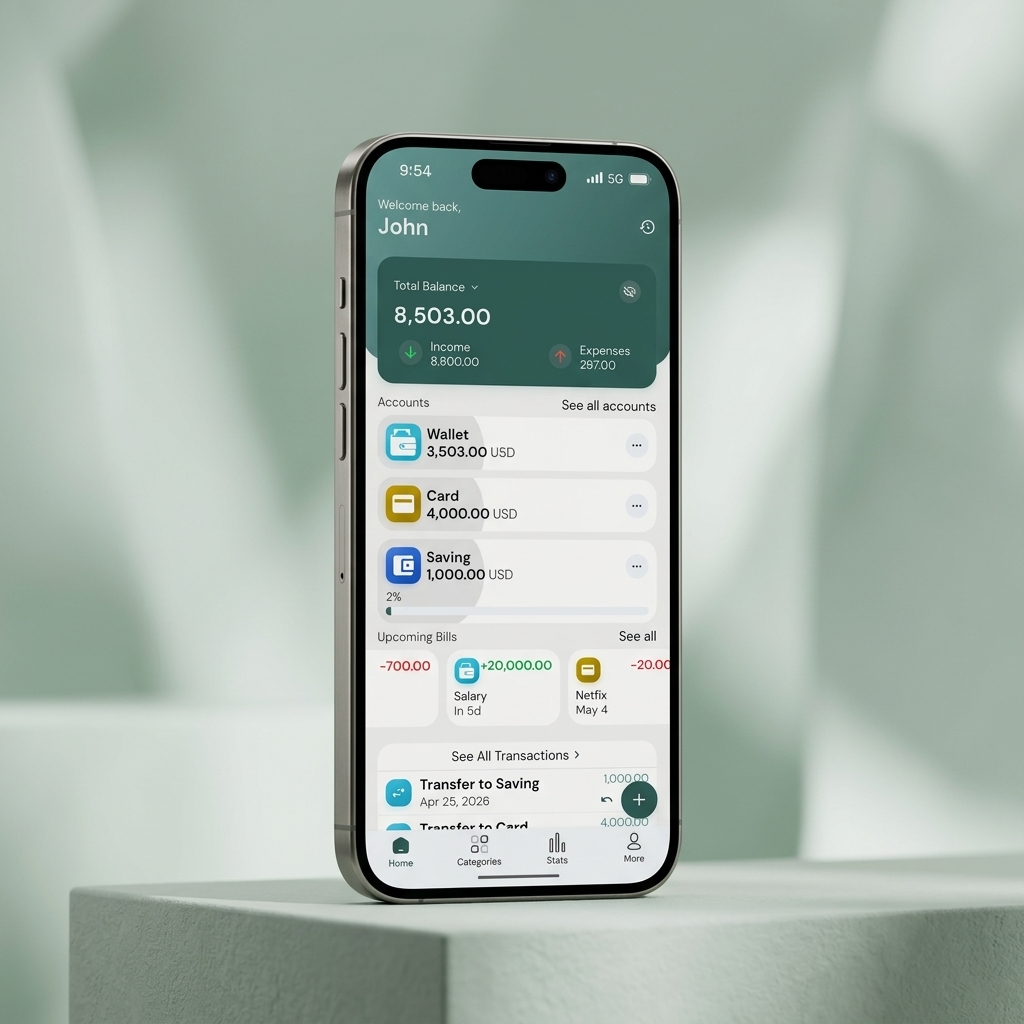
Every finance app wants your data in the cloud. Easymony does the opposite. Your income, spending habits, account balances, goals — all of it lives on your device. That is not a side effect. It is the core of how the app works. This changes how the app behaves, how fast it feels, and how safe your information actually is.
Offline-first means the app runs without an internet connection
Cloud sync is optional, not required. Most finance apps are the reverse: they need a connection to work and only cache data locally when the network drops. Easymony stores your data on your device from the moment you enter it. The app never talks to a server to show you your financial picture.
Because there is no server round-trip, the app responds instantly
No loading spinners. No waiting for transactions to sync. Your data is local and shows up in milliseconds. That matters for expense tracking. The longer it takes to log a purchase, the less likely you are to do it. Easymony removes that waiting.
There is also no server to breach
No central database means no mass data leak. Equifax exposed 147 million records in 2017. Capital One exposed 100 million accounts. Those were centralized servers. Easymony cannot have that kind of breach because the data is not in one place.
The app runs on SQLite, the same engine used by your phone's operating system and most major browsers
Every transaction writes to local storage instantly. No network call, no latency. SQLite has been tested for over twenty years and handles databases up to 281 terabytes. For a personal finance app storing tens of thousands of transactions, it is more than enough.
Offline-first also means the app works when your connection drops
Subway, rural area, international travel — your budget app should not stop working because of a network issue. Cloud-based apps become useless offline. Easymony does not care about your network status.
There is a subtler privacy angle too
Even when an app does not collect data, connecting to a server creates metadata: connection logs, IP addresses, usage patterns. Offline-first apps produce no network traffic. Nothing to log, nothing to leak.
The cost side is straightforward
Cloud apps need servers, databases, CDNs, and teams to maintain them. Those costs pass to users through subscriptions or data sales. Easymony has no server costs. That is why the free tier is generous and Premium is $0.99/month.
The trade-off is real: your data lives on one device
If you lose the phone without a backup, the data is gone. Easymony includes backup and restore for that reason. You export an encrypted ZIP file and store it where you want. Premium users get automatic Google Drive sync. The difference is you control the backup, not the app.
What about sharing a budget with a partner? Export your database and share the file
It is not real-time sync, but it puts you in control of when and how data moves between devices.
A 2025 Pew Research study found that 72% of Americans feel they have little control over how companies collect their personal data
That distrust is pushing people toward apps that respect privacy by design, not by policy. Offline-first apps work for the user, not for advertisers or data brokers.
Other categories already figured this out
Obsidian and Logseq store notes locally. KeePass stores passwords offline. Personal finance is catching up. Your most sensitive data belongs on your device.
Easymony is a budgeting app that stores your data locally
That is the feature, not a limitation. It is fast, private, and does not need to know who you are to work.
Related Articles
Mastering PDF Reports for Better Budgeting
A transaction history PDF is useful. But you can also use it to spot spending patterns you would miss scrolling through individual entries.
How to Set Up Budget Categories That Actually Work
Preset labels like 'Food' lump groceries, dining out, and coffee into one bucket. Custom categories give you a clearer picture of where your money goes.